
Key takeaways
- The rectum produces no lubrication of its own. Whatever you apply is the only lubrication there is — this is the single fact that changes everything else.
- Rectal tissue is one cell layer thick. Vaginal tissue is many layers. That is why fragility, not friction, is the governing concern.
- Different pH target. The WHO/UNFPA/FHI360 advisory note suggests about 4.5 for vaginal lubricant and 5.5–7 for rectal.
- Osmolality matters more here, not less. Strongly hyperosmolar lubricants have been shown to strip the lining of the distal colon.
- Thickness is a feature. A cushioning gel stays where you put it; a thin lubricant runs off.
- Numbing lubricants are the one category to think hard about. Pain here is a warning signal, and switching it off does not remove what caused it.
- Oil breaks latex. With condoms, water-based or silicone only.
Most advice about anal lubricant stops at "use lots of it." That is true and nowhere near sufficient. The rectum is a fundamentally different environment from the vagina — different tissue architecture, different pH, and no lubrication of its own — which means the product that works beautifully for one job can be the wrong tool for the other. Here is what actually separates a good anal lubricant from a good vaginal one, and what the research says about why it matters.
Why can't I just use my normal lube?
You often can, but the margin for error is smaller. The vagina self-lubricates and is lined with several layers of stratified epithelium. The rectum produces no lubrication at all and is lined with a single layer of columnar cells. Less cushioning, thinner barrier, no natural top-up — so viscosity, staying power and formula gentleness all matter more.
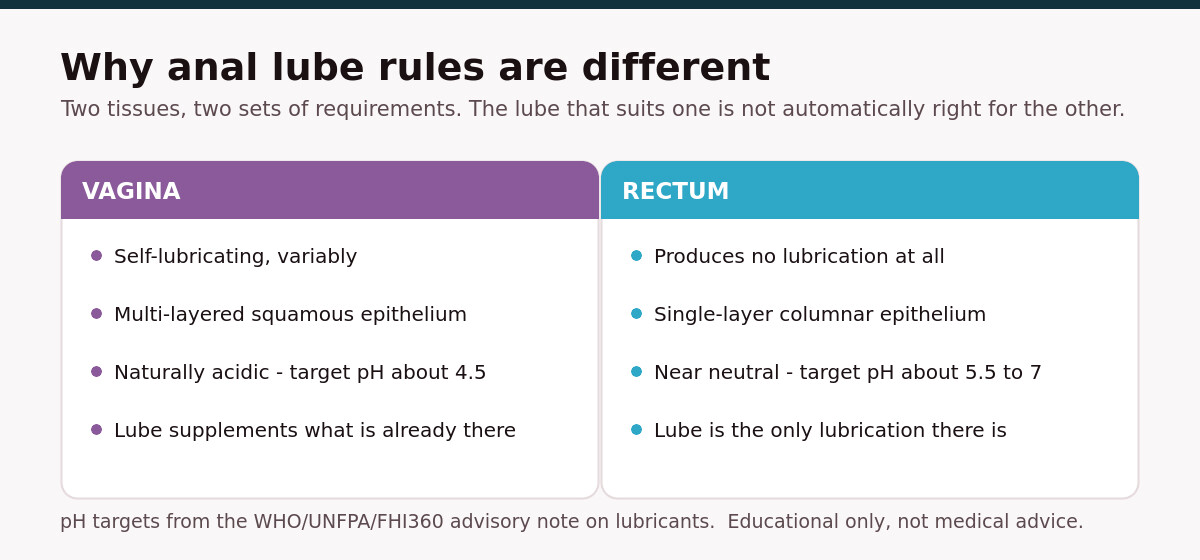
That single-layer detail is not a technicality. It is the reason clinicians treat the rectum as more susceptible to tissue damage than vaginal or penile tissue, and why adequate lubrication is framed as a health measure rather than a comfort preference. The CDC's risk reduction guidance is direct about it: use plenty of lubricant during anal sex to help keep condoms from tearing, and use water- or silicone-based products, never oil.
What the osmolality research actually found
Osmolality is the concentration of dissolved particles in a lubricant. When it is far higher than the surrounding tissue, water is drawn out of the cells lining the bowel. Studies applying strongly hyperosmolar gels rectally found measurable stripping of the epithelial surface — the protective lining thinning and shedding.
The foundational work here is a study in the Journal of Infectious Diseases, Hyperosmolar sexual lubricant causes epithelial damage in the distal colon, which found that rectally applied hyperosmolar gels induced greater epithelial denudation than iso-osmolar ones. Because that denudation plausibly increases susceptibility to infection, the authors raised it as a potential transmission concern.
What is worth being precise about — and where a lot of internet writing overreaches — is that cell damage in a dish or a model is not the same as demonstrated real-world infection risk. A later macaque study found that a highly osmolar lubricant did produce acute cytotoxicity but did not increase the risk of SHIV infection. A systematic review of lubricants and sexual health reaches a similarly measured conclusion: some high-osmolality, low-pH products can damage genital and rectal tissue, but in-vivo evidence that lubricants increase infection risk is scarce.
So the honest summary is not "hyperosmolar lube gives you HIV." It is: these formulas demonstrably irritate and thin a tissue that is already only one cell thick, the mechanism for why that would be bad is plausible, the epidemiological proof is not there, and there is no upside to choosing the harsher option. The WHO ceiling of 1,200 mOsm/kg remains the number to aim under.
The frustrating part: almost no retail bottle prints its osmolality. Until that changes, the usable proxies are a short ingredient list, low glycerin and propylene glycol content, and a thickener like xanthan gum or hyaluronan doing the work of building viscosity instead of a heavy glycol load.
What actually makes a good anal lubricant
| Property | Why it matters here | What to look for |
|---|---|---|
| Viscosity | There is no natural lubrication to supplement, and a thin fluid runs off rather than cushioning | A gel or glide, not a watery liquid |
| Staying power | Reapplying mid-session is disruptive and often skipped | Silicone, or a water-based formula built on xanthan gum or hyaluronan |
| Osmolality | Hyperosmolar formulas strip a single-cell-layer lining | Under 1,200 mOsm/kg; short ingredient list as a proxy |
| pH | The rectum is near-neutral, not acidic like the vagina | Around 5.5–7; a vaginal-pH product is more acidic than this tissue wants |
| Condom compatibility | Adequate lubrication is what stops breakage | Water-based or silicone. Never oil with latex |
| Toy compatibility | Silicone lube degrades silicone toy surfaces over time | Water-based with silicone toys, or a condom over the toy |
| No anaesthetic | Pain is the signal that tells you to stop or slow down | Skip numbing formulas unless a clinician has advised otherwise |
Water-based or silicone?
Both are correct answers to different questions. Silicone lasts by a wide margin, does not absorb, and needs no reapplication — genuinely the easiest choice for longer sessions, and safe with latex condoms. Its two costs are that it degrades silicone toys and needs soap to wash off. Browse the silicone lubricant range if that is the trade you want.
Water-based is the more flexible option: safe with every toy material, easy cleanup, and — the point people miss — a thick water-based glide can be reactivated with a few drops of water rather than more product. It needs reapplying, which is a small price for compatibility with everything. See our companion guide on choosing a personal lubricant for the wider comparison.
A short-ingredient-list example: pjur Analyse Me Comfort
A useful reference point for what a purpose-built water-based anal glide looks like. The full list is eight items: water, glycerin, xanthan gum, sodium hyaluronate, benzyl alcohol, sodium benzoate, potassium sorbate and citric acid.
What that tells you: sodium hyaluronate — hyaluronan — is doing the heavy lifting. It is strongly water-attracting, which builds viscosity and holds moisture without needing a large glycol load to get there. Xanthan gum adds body. Citric acid keeps the formula on the acidic side of neutral. The preservatives are the benzoate/sorbate system rather than parabens, and it is latex-condom safe.
Honest caveat, same as always: glycerin is present, and pjur does not print an osmolality figure on the retail bottle. It is a well-constructed formula by the standards of the category, not a laboratory-verified one.
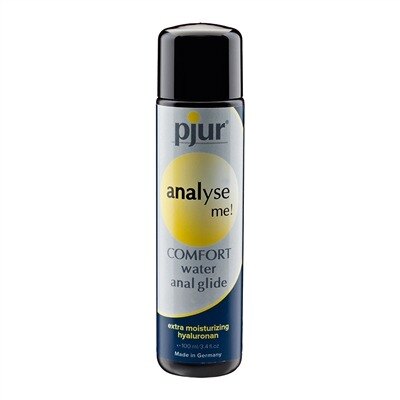
pjur Analyse Me Comfort Water-Based Anal Glide, 3.4 oz
Eight-ingredient water-based glide built on hyaluronan for viscosity without a heavy glycol load. Long lasting, latex-condom safe, no anaesthetic. Made in Germany.
View productCompare the rest of the range in the anal lubricants category.
The numbing lubricant question
Desensitising and "relax" lubricants contain a topical anaesthetic — usually benzocaine or lidocaine. They do reduce sensation. The problem is that discomfort during anal sex is information: it tells you to slow down, add lubricant, or change angle. Remove the signal and you can keep going through something that is causing damage without knowing it.
This is not a fringe worry, and you can see the tension on the products themselves. Numbing anal lubricants commonly carry drug-facts labelling for the temporary relief of pain or soreness, are marked for external use only, and instruct you to stop and see a doctor if bleeding occurs. That is a product telling you, in its own words, that it is not designed to make internal penetration comfortable.
Reasonable positions exist. Someone using a small amount externally, having already established that they can do this comfortably without it, is in a different situation from someone using anaesthetic to push past a hard limit. The second is where injuries come from. If pain is the recurring obstacle, that is a signal worth investigating — persistent pain can point to a fissure, haemorrhoids or pelvic floor tension, all of which are treatable and none of which are solved by numbing them. The NIDDK's overview of haemorrhoids and anal fissures is a useful plain-language starting point.
How to use it well
- Use more than feels reasonable. The most common mistake by a wide margin. There is no natural lubrication being added to what you apply.
- Apply to both the receiving partner and whatever is being inserted, inside and out — not one surface.
- Reapply early. Do not wait for drag. If a water-based formula stiffens, a few drops of water will often revive it without opening the bottle.
- Go slowly at the start. The external sphincter relaxes on its own schedule; time and lubricant do more than force ever will.
- Stop if there is pain. Not "push through" — stop, add lubricant, change position or stop for the night.
- Patch-test anything new, especially warming, tingling or flavoured formulas. Mucosal tissue is far less forgiving than forearm skin.
- Match lube to toy material. Silicone toy plus water-based lubricant, or roll a condom over the toy.
- Change condoms between anal and vaginal, and wash toys in between. Gut bacteria in the vagina is a straightforward route to infection.
When to see a clinician
Some soreness after a first attempt is unremarkable. These are not: bleeding that is more than a trace or happens repeatedly, pain that persists for days, a sharp tearing sensation during penetration, any change in continence, or a lump that does not resolve. Anal fissures and haemorrhoids are common, treatable, and much easier to deal with early than after months of repeat irritation.
It is also worth knowing that persistent unexplained anal bleeding always deserves assessment on its own terms rather than being attributed to sex — MedlinePlus on anal cancer covers why. And if you are having anal sex with new or multiple partners, regular STI screening that includes rectal swabs is the relevant precaution; a throat-and-urine panel will not detect a rectal infection.
Frequently asked questions
What is the best lube for anal sex?
A thick, long-lasting formula with no anaesthetic. Silicone lasts longest and needs no reapplication but degrades silicone toys. A water-based glide built on xanthan gum or hyaluronan is the more flexible choice and works with every toy material. Both are condom-safe; oil is not.
Can I use regular lube for anal sex?
Usually yes, but a thin vaginal lubricant runs off and gets absorbed quickly, which is exactly what you do not want when there is no natural lubrication to fall back on. A thicker, purpose-made glide is a meaningful improvement rather than marketing.
Is numbing anal lube safe?
Anaesthetic lubricants remove the pain signal that tells you to slow down or stop, so injury can occur without you noticing. Many are also labelled for external use only. If pain is the recurring barrier, that is worth investigating with a clinician rather than masking — fissures, haemorrhoids and pelvic floor tension are all treatable.
Does anal lube need a different pH from vaginal lube?
Yes. The vagina is acidic, so vaginal lubricants target about pH 4.5. The rectum is near neutral, and the WHO advisory note suggests roughly 5.5–7 for rectal use. A strongly acidic product is more acidic than this tissue wants.
Is silicone or water-based better for anal?
Silicone if you want maximum staying power and are not using silicone toys. Water-based if you want compatibility with every toy material and easier cleanup, accepting that you will reapply. Both are safe with latex condoms.
How much lube should I use?
Considerably more than for vaginal sex, and reapplied before it is needed rather than after. Whatever you apply is the only lubrication present, and running dry mid-session is where friction injuries happen.
Can lubricant increase the risk of infection?
Strongly hyperosmolar lubricants have been shown to strip cells from the lining of the distal colon, and the mechanism by which that could raise infection risk is plausible. Real-world evidence that lubricants increase transmission is limited and mixed. Adequate lubrication reduces condom breakage, which is a clear protective benefit.
Sources and further reading
- WHO/UNFPA/FHI360 — Use and procurement of additional lubricants for male and female condoms: advisory note
- Hyperosmolar sexual lubricant causes epithelial damage in the distal colon (Journal of Infectious Diseases)
- Rectal application of a highly osmolar personal lubricant in a macaque model (National Library of Medicine)
- Lubricants for the promotion of sexual health and well-being: a systematic review
- CDC — What Can Decrease HIV Risk?
- CDC — Condom Use: An Overview
- NIDDK — Hemorrhoids
- MedlinePlus — Anal Cancer
Medical disclaimer. This article is educational and is not medical advice. It does not diagnose, treat, cure or prevent any disease. Personal lubricants are regulated by the U.S. Food and Drug Administration as medical devices; formulations change, so read the label on the bottle you have bought. If you have bleeding, persistent pain, incontinence or a lump that does not resolve, speak to a qualified healthcare professional.