
Key takeaways
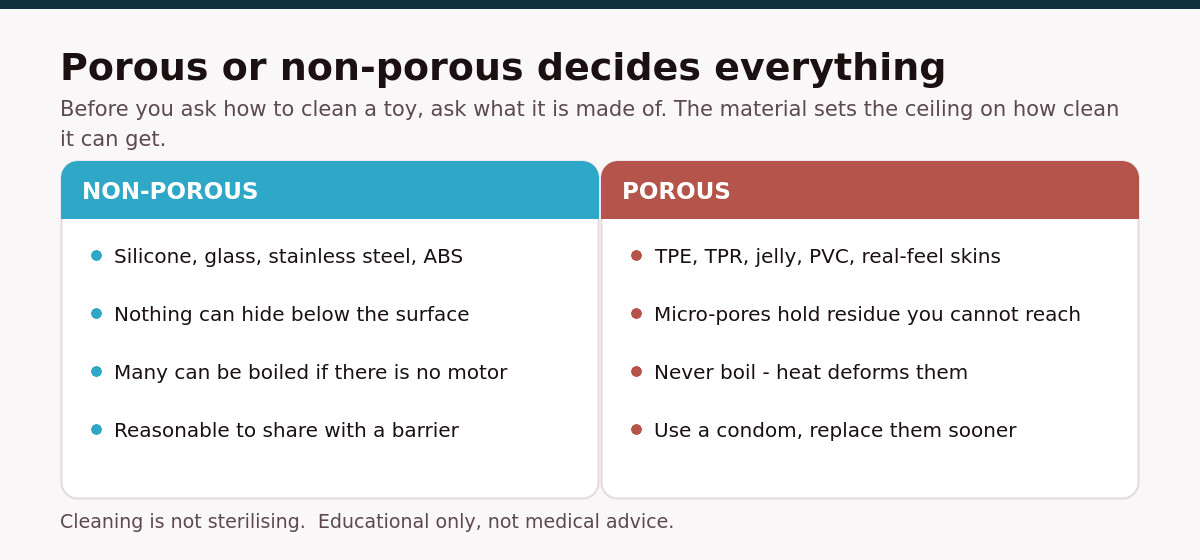
- The material decides how clean a toy can get. Non-porous surfaces — silicone, glass, steel, hard ABS plastic — can be cleaned properly. Porous ones cannot, no matter what you use on them.
- Cleaning and disinfecting are different jobs. The CDC defines cleaning as physically removing germs and soil, and disinfecting as killing them with chemicals. Most toy cleaners do the first.
- Plain soap and warm water is the baseline, and it is a good one. A dedicated cleaner buys convenience, not a fundamentally deeper clean.
- Cleaning reduces contamination rather than eliminating it. In one study, HPV DNA was still detectable on vibrators immediately after cleaning with a commercial cleaner.
- Silicone outperformed TPE in that same study — the silicone toy was clear at 24 hours, the thermoplastic elastomer one was not.
- Use a condom on any shared toy, and change it between partners and between orifices. This is the single highest-value habit here.
- Dry completely before storing. Damp storage, not dirty storage, is what ruins toys and grows things in them.
Nearly every guide to cleaning sex toys gives the same instruction — warm water, mild soap, air dry — and then stops. That advice is correct and it is also the least interesting part of the answer. What actually determines whether a toy is safe to use again is what it is made of, whether it has a motor inside it, and whether anyone else has used it. Get those three right and the cleaning routine becomes obvious. Get them wrong and no cleaner on the shelf will rescue you.
What actually makes a sex toy unsafe to reuse?
Three things, in order of how much they matter: a porous surface that holds residue you cannot reach, moisture trapped during storage, and sharing without a barrier. Ordinary surface soil is the easy problem — soap and water handles it. The other three are what turn a toy into a genuine hygiene issue.
Body fluids, lubricant and skin cells are all left behind after use, and they are food for bacteria and yeast. On a non-porous surface that residue sits on top, where soap and water can lift it off. On a porous surface it sinks into micro-cavities that are smaller than anything you can scrub, and a rinse simply carries water over the top of it.
This is not a sex-toy-specific finding so much as a materials one. Research on children's and household toys has repeatedly found that soft, porous items carry heavier bacterial loads than hard non-porous ones, and that plastics in prolonged contact with water support biofilm growth including opportunistic pathogens. The physics are the same whatever the toy is for.
Does a dedicated toy cleaner do anything soap does not?
Mostly it does the same job more conveniently. A spray you can use without dismantling a rechargeable toy at the sink is genuinely useful. But most toy cleaners are cleaners, not disinfectants — they lift residue rather than making a kill claim — and the honest comparison is against warm water and mild soap, which the CDC notes already removes most germs from a surface.
It is worth being precise about the vocabulary, because product marketing in this category is loose with it. The CDC's guidance on cleaning and disinfecting separates three things: cleaning removes germs and dirt with soap, water and physical scrubbing; sanitising lowers germ numbers to a level considered safe; disinfecting uses chemicals to kill most germs. It also makes the point that surfaces must be cleaned before anything is disinfected, because soil physically shields germs from the chemical.
So a "toy cleaner" that lists water and a few botanical extracts is doing step one. That is not a criticism — step one is the step that matters most for a toy only you use, and doing it consistently beats doing something more aggressive occasionally. It just means you should not read the bottle as a promise of sterility.
A worked example: what is actually in one
Take the four-ingredient formula on the System JO NATURALOVE organic toy cleaner we stock: water, organic lemon fruit extract, organic aloe leaf extract and organic açaí fruit extract. It is soap-free and USDA-certified to more than 95% organic content, and the directions are to spray the surface, then let the toy air dry for around ten minutes before use.
Read that list honestly and it tells you what the product is: a gentle, no-rinse surface cleaner that will not leave a soap film on silicone and will not sting sensitive tissue. Read it as a disinfectant and you have misread it — there is no agent in there making a kill claim, and none is advertised. For the job of "clean my own toy quickly and gently between uses," it is well matched. For "make this safe to hand to someone else," nothing in a spray bottle achieves that on its own.
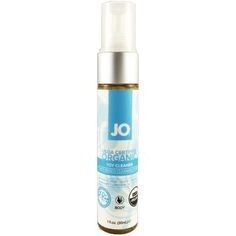
JO Naturalove USDA Organic Toy Cleaner, 4 oz (120 ml)
Soap-free spray cleaner, USDA-certified to over 95% organic ingredients. Four ingredients: water, lemon, aloe and açaí extracts. Spray, then air dry about ten minutes — no rinse step in the directions. Made in the USA by System JO.
View productHow do I clean each material?
Non-porous and motor-free items tolerate the most: soap and water always, boiling or a dishwasher cycle for solid silicone, glass and steel. Anything with a motor, a battery or a USB port gets wiped rather than submerged — unless the manufacturer rates it waterproof. Porous materials get soap and water only, plus a condom and a shorter replacement cycle.
| Material | Routine clean | The trade-off to know |
|---|---|---|
| Solid silicone (no motor) | Soap and warm water; can be boiled a few minutes or run on a dishwasher top rack without detergent | Silicone lubricant can degrade a silicone surface over time — pair with water-based, or use a condom |
| Silicone with a motor | Soap and water if rated waterproof; otherwise a damp cloth and cleaner spray, keeping ports dry | "Splashproof" is not "submersible" — check the rating before it goes near a tap |
| Borosilicate glass | Soap and water, boilable, dishwasher safe | Inspect for chips every time; a cracked or chipped piece is retired, not repaired |
| Stainless steel | Soap and water, boilable, dishwasher safe | Heavy and heat-retaining — it will hold whatever temperature you leave it at |
| ABS hard plastic | Soap and water or a cleaner spray | Non-porous but not heat-tolerant; boiling warps it |
| TPE / TPR | Soap and water only, dried thoroughly | Porous. Cannot be fully decontaminated, degrades with time, and is the material that stayed HPV-positive longest in testing |
| Jelly / soft PVC | Soap and water; always use a condom | Porous, often softened with phthalates, and prone to going sticky or weeping oil as it ages |
On phthalates specifically, it is worth keeping the temperature down. These plasticisers are widespread in consumer goods, and the FDA's position on the one still commonly used in cosmetics, diethyl phthalate, is that it does not have safety concerns at current cosmetic exposure levels. That is a narrower statement than either side of the internet argument tends to make it. The stronger practical reason to prefer silicone, glass or steel is not a toxicology scare — it is that those materials can actually be cleaned, and jelly cannot.
Never put a motor in boiling water, and never use a household disinfectant, bleach or alcohol on a toy that goes inside you. Residue from those products irritates mucosal tissue, which is far less forgiving than the skin on your hands. If a manufacturer's care leaflet contradicts anything here, follow the leaflet — it knows what its own materials and seals can take.
What does the research say about sharing toys?
That cleaning reduces contamination without reliably eliminating it. In a 2014 study in Sexually Transmitted Infections, vibrators used by women with vaginal HPV were still HPV-positive on 56% of swabs taken immediately after cleaning with a commercial cleaner. This is the strongest practical argument for putting a condom on a shared toy rather than relying on cleaning between users.
The study is small but unusually direct, and it is the most useful piece of evidence in this whole area. Twelve women each used two vibrators on separate occasions — one thermoplastic elastomer, one silicone — and swabs were taken immediately after use, immediately after cleaning, and 24 hours after cleaning. HPV was found in the vaginal samples of 9 of the 12.
| Sample point | TPE vibrator | Silicone vibrator |
|---|---|---|
| Before cleaning | 89% positive | 67% positive |
| Immediately after cleaning | 56% positive | 44% positive |
| 24 hours after cleaning | 40% of those still positive | None detected |
Two things follow from that. The first is the material point again, in hard numbers: the silicone toy cleared completely by 24 hours and the TPE one did not. The second is that "I cleaned it" is not the same claim as "it is now safe to share."
The honest caveats matter here too, and most write-ups of this study skip them. Twelve participants is a small sample. More importantly, the test detects HPV DNA, not infectious virus — finding genetic material on a surface is not proof that enough live virus remains to transmit an infection. The authors themselves framed the result as supporting the potential for transmission and as evidence that the field needs proper evidence-based cleaning recommendations. So: a good reason to use a barrier, not a reason to panic about a toy you use alone.
For shared use, a condom on the toy is cheap, effective and changeable between partners — the same logic the CDC applies to condoms generally. Cleveland Clinic's safe sex guidance makes the same two points: do not pass accessories back and forth uncleaned, and use an external condom on toys during penetrative sex.
The rule people forget: front to back
Change the condom, or wash the toy, before it moves from anal to vaginal use. Introducing gut bacteria to the vagina is a well-understood route to infection, and it is a far more common real-world problem than anything exotic. If you would like the wider picture on lubricant choice for that kind of play, our guide to lube for anal sex covers the tissue differences in more depth.
How should I store them?
Completely dry, separately, and out of direct sunlight. Damp is the enemy — a toy put away before it has dried is the most common way people grow something unpleasant on an otherwise well-cleaned item. Store silicone pieces so they are not pressed against other silicone or against soft plastics.
The specifics are short and worth following:
- Dry fully before it goes away. Pat with a lint-free cloth and then let it air dry the rest of the way. Ten minutes on a towel is usually enough; a sealed drawer is not a drying rack.
- Give each item its own bag or pouch. Most toys ship with one. Different materials pressed together for months can react — soft PVC in particular can leach plasticiser into whatever it is touching and leave both items tacky.
- Keep silicone away from silicone. Two silicone surfaces in prolonged contact can bond or mar each other.
- Cool, dark and dry. Heat and UV age elastomers. A bedside drawer is fine; a sunny windowsill or a hot car is not.
- Take the batteries out of anything battery-powered that you are storing for a while — leaking cells destroy more toys than wear does. For rechargeables, store partly charged rather than flat.
- Do not store it dirty "to deal with later." Residue dries on, and porous materials will have absorbed it by the time you get back to it.
What a low-maintenance toy looks like
If cleaning is the part you know you will cut corners on, buy for it. A fully waterproof, seamless, non-porous item with no battery hatch is the easiest thing in this category to look after — it goes under the tap and that is the whole routine.
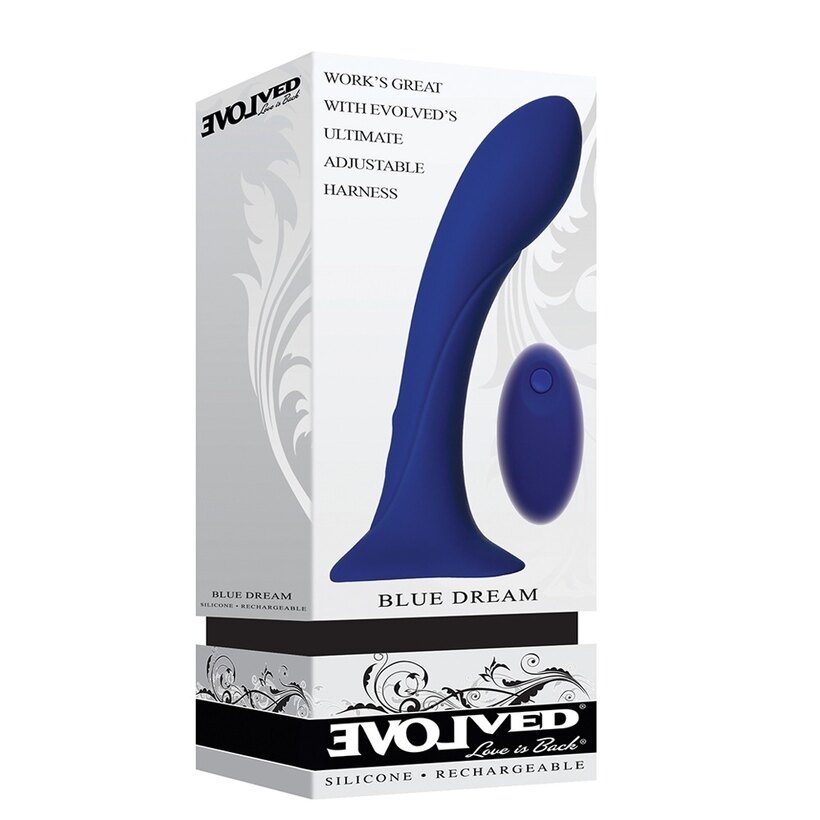
Blue Dream Silicone Rechargeable Vibrator
Silicone shaft with an ABS remote, 7 vibration speeds, USB rechargeable. Stated as waterproof and submersible, and phthalate- and latex-free — which is what makes it straightforward to wash properly. Shaft 7 in, harness compatible.
View productBrowse the wider adult toys range, and if you are pairing a lubricant with a silicone piece, the water-based lubricants are the compatible default — our guide to choosing a personal lubricant explains why silicone-on-silicone is the one combination to avoid.
When should I throw a toy away?
When the surface changes. Tackiness, a persistent smell that survives washing, cracks, cloudiness, splits at a seam, or any chip in glass — all of these mean the surface can no longer be cleaned, and none of them are fixable. Porous materials reach that point years sooner than silicone, glass or steel.
A sticky or weeping surface on a jelly or PVC item is plasticiser migrating out of the material as it ages, and it will not wash off because it is not on the surface, it is the surface. A smell that returns after a proper wash means residue has gone somewhere you cannot reach. Both are retirement signals rather than cleaning problems.
Non-porous items are different — a good silicone, glass or steel piece can last many years provided the seals and any motor still work. Inspect glass for chips before every use, because a chipped edge in a body-safe material is still a laceration risk.
When to see a clinician
Most toy-related irritation settles in a day or two. These are worth a professional opinion: unusual discharge, a persistent change in smell, itching or burning that lasts more than a couple of days, pain during or after use that is new, any sore or ulcer, or bleeding that is not obviously a minor scratch. MedlinePlus on vaginitis is a good plain-language starting point on what the common causes look like and why self-diagnosis often goes wrong — bacterial vaginosis, yeast and trichomoniasis are treated differently and can feel similar.
Two situations deserve immediate care rather than a wait-and-see: an object that cannot be retrieved, and a toy used anally that has no flared base and has moved out of reach. Neither is a home-remedy problem, and clinicians deal with both routinely and without judgement.
Frequently asked questions
Can I just use hand soap and water on sex toys?
Yes, for most non-porous toys, and it is the baseline everything else is measured against. Use a mild, unscented soap and rinse thoroughly, because leftover fragrance and detergent residue is a common cause of irritation. A dedicated toy cleaner is mainly a convenience for items you would rather not carry to a sink.
Does a toy cleaner disinfect or sterilise a toy?
Generally no, and most do not claim to. Cleaning physically removes germs and residue; disinfecting kills them with chemicals, and sterilising eliminates them entirely. Botanical, soap-free sprays are cleaners. For non-porous, motor-free silicone, glass or steel, boiling is the closest thing to sterilising available at home.
Can I boil my sex toy?
Only if it is solid silicone, borosilicate glass or stainless steel with no motor, battery or electronics inside. A few minutes in boiling water is enough. Never boil ABS plastic, TPE, TPR, jelly or PVC — they warp or degrade — and never boil anything with a seam, seal or charging port.
How do I clean a rechargeable or waterproof vibrator?
Check the rating first. If the manufacturer states it is waterproof and submersible, soap and warm water is fine, keeping the charging contacts dry and letting it drain fully afterwards. If it is only splashproof, wipe it down with a damp cloth or a cleaner spray instead. Never submerge a toy with an open battery hatch.
Is it safe to share sex toys if I clean them between users?
Cleaning lowers the risk but does not remove it. In one study, HPV DNA was still detectable on just over half of vibrator swabs taken immediately after cleaning with a commercial cleaner. Use a condom on the toy and change it between people — that is more reliable than any cleaning routine, and it is easier.
How often should I replace a porous toy?
Sooner than a silicone one, and on the evidence of the surface rather than the calendar. Any tackiness, a smell that survives washing, discolouration or softening means retire it. Because porous materials cannot be fully decontaminated, they are best treated as consumables and always used with a condom.
What is the best way to store sex toys long term?
Completely dry, each in its own pouch, somewhere cool and dark. Keep silicone from touching other silicone or soft PVC, remove batteries from anything being stored for a while, and store rechargeables partly charged rather than fully flat.
Sources and further reading
- CDC — When and How to Clean and Disinfect Your Home
- A study of human papillomavirus on vaginally inserted sex toys, before and after cleaning (Sexually Transmitted Infections, 2014)
- FDA — Phthalates in Cosmetics
- CDC — Condom Use: An Overview
- MedlinePlus — Vaginitis
- Plastic materials in contact with potable water and biofilm growth (National Library of Medicine)
- Cleveland Clinic — What You Should Know About Safe Sex Practices
Medical disclaimer. This article is educational and is not medical advice. It does not diagnose, treat, cure or prevent any disease. Care instructions vary between manufacturers and materials — where a product's own leaflet differs from the general guidance here, follow the leaflet. If you have persistent irritation, unusual discharge, pain or an object that cannot be retrieved, speak to a qualified healthcare professional.