
Key takeaways
- Water-based lubricant is the safe default. It works with latex condoms, with silicone toys, and rinses off with water.
- Silicone lasts longest and survives water, but it degrades silicone toys.
- Oil-based products break latex condoms. Keep them for external massage only.
- Two label numbers matter for vaginal use: osmolality under 1,200 mOsm/kg and pH near 4.5, per the WHO/UNFPA/FHI360 advisory note.
- Friction is not a character flaw. Natural lubrication varies with hormones, medication, stress, sleep and the menstrual cycle — using lube is maintenance, not rescue.
- If sex hurts even with lube, that is a medical question, not a shopping question. Talk to a clinician.
Walk down the personal-care aisle and every bottle promises the same three things: silky, long-lasting, natural. None of that tells you the one thing that actually matters — whether the formula is compatible with your body, your condoms and your toys. This guide covers the science behind lubricant selection, the two label numbers gynecologists care about, and how to match a base to what you are actually doing.
What does personal lubricant actually do?
A personal lubricant reduces friction between skin surfaces so that movement is comfortable instead of abrasive. It does not "fix" arousal — it replaces or supplements the fluid your body produces, which varies enormously with hormone levels, hydration, medication, stress and time of the month.
The most common misconception about lube is that needing it signals a problem. It does not. Natural lubrication is not a fixed trait; it is a moving target. Hormonal contraceptives, antihistamines, SSRIs, breastfeeding, perimenopause and simple dehydration all reduce it. So does being rushed. Longer sessions outlast natural lubrication almost by definition, which is why lubricant is standard equipment rather than a last resort.
There is also a mechanical argument. Adequate lubrication reduces micro-abrasion of delicate mucosal tissue. Those micro-tears are uncomfortable in the short term and, in the context of unprotected sex, can increase susceptibility to infection. The CDC's condom guidance recommends water- or silicone-based lubricant with latex condoms specifically because adequate lubrication reduces the risk of breakage.
Water-based vs silicone vs oil: which lubricant should you use?
Choose water-based for everyday use, sensitive skin and silicone toys. Choose silicone for long sessions, shower or bath play, and anywhere a water-based formula would dry out. Choose oil-based only for external massage — oil destroys latex condoms.
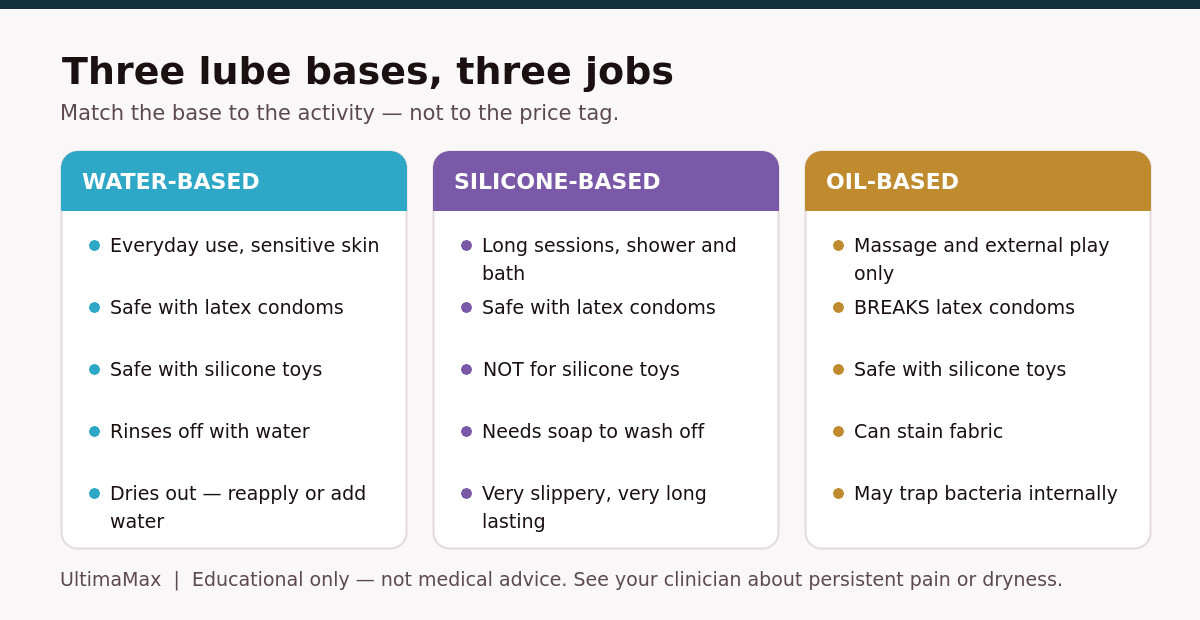
| Factor | Water-based | Silicone-based | Oil-based |
|---|---|---|---|
| Latex condom safe | Yes | Yes | No — degrades latex |
| Silicone toy safe | Yes | No — causes surface damage | Yes |
| How long it lasts | Short; dries or absorbs | Very long | Long |
| Works in water | No — washes away | Yes | Partly |
| Cleanup | Rinses with water | Needs soap | Soap; may stain fabric |
| Internal vaginal use | Best choice | Generally fine | Not recommended |
| Best for | Daily use, sensitive skin, toys | Long sessions, shower, massage | External massage only |
One nuance that trips people up: "silicone lube damages silicone toys" is true but often overstated. The reaction is gradual surface degradation, not instant melting, and it varies by toy grade. The practical rule is simple — if the toy is silicone, reach for water-based, or use a condom over the toy. Browse the full water-based lubricant range or the silicone lubricant range to compare formulas side by side.
Which lubricant is safest for the vagina?
For internal vaginal use, the safest lubricants have an osmolality below 1,200 mOsm/kg and a pH close to 4.5. Those two numbers, recommended in the WHO/UNFPA/FHI360 advisory note, keep the formula close to the vagina's own chemistry instead of pulling water out of the tissue.
Osmolality — the number almost nobody prints
Osmolality measures the concentration of dissolved particles in a fluid. Healthy vaginal secretions sit somewhere around 260–380 mOsm/kg. When a lubricant is far more concentrated than that, osmosis does what osmosis does: water moves out of the cells lining the vaginal wall and into the lubricant. The epithelium dries, thins and becomes more fragile.
This is not a fringe concern. A widely cited safety analysis published in the National Library of Medicine, Characterization of Commercially Available Vaginal Lubricants: A Safety Perspective, found that several mainstream products measured several times above the 1,200 mOsm/kg ceiling. Laboratory work has also shown that strongly hyperosmolal formulas are toxic to the Lactobacillus species that keep the vaginal environment acidic and hostile to pathogens.
The frustrating part is that almost no consumer bottle prints its osmolality. In practice, that leaves you with proxies: shorter ingredient lists, lower glycerin and propylene glycol content, and manufacturers who publish specifications on request.
pH — the easier number
The healthy vaginal environment is acidic, roughly pH 3.8–4.5. The WHO advisory note recommends vaginal lubricants near 4.5 and rectal lubricants nearer 5.5–7, because rectal tissue is not acidic. A strongly alkaline lubricant nudges the vaginal environment toward conditions that favour bacterial vaginosis.
What ingredients should you look for on the label?
| Ingredient | What it does | What to know |
|---|---|---|
| Water (Aqua) | Base carrier | Should be the first ingredient in any water-based formula |
| Glycerin / glycerol | Humectant, adds slip and sweetness | Raises osmolality at high concentration. Some people prone to recurrent yeast infections do better avoiding it |
| Propylene glycol | Humectant and preservative | Same osmolality issue as glycerin; a common contact irritant |
| Xanthan gum / cellulose | Thickener | Adds body without raising osmolality much — a good sign |
| Parabens | Preservative | Effective, but a known irritant for people with paraben sensitivity |
| Chlorhexidine gluconate | Antiseptic preservative | Antibacterial — can disrupt healthy vaginal flora with frequent use |
| Nonoxynol-9 | Spermicide | Irritating to mucosa with repeated use; not recommended as a routine lubricant additive |
| Fragrance / flavour | Scent and taste | A leading cause of contact irritation. Keep flavoured products external |
| Menthol / capsaicin ("warming", "tingling") | Sensation | Fun for some, genuinely painful for others. Patch-test first |
Skip entirely: petroleum jelly, baby oil, coconut oil and hand lotion used as internal lubricant with condoms. Oils degrade latex within minutes, and the residue is difficult for the body to clear, which can encourage bacterial overgrowth. If you use latex condoms, water- or silicone-based is the only correct answer.
A short-ingredient-list example: pjur MED Natural
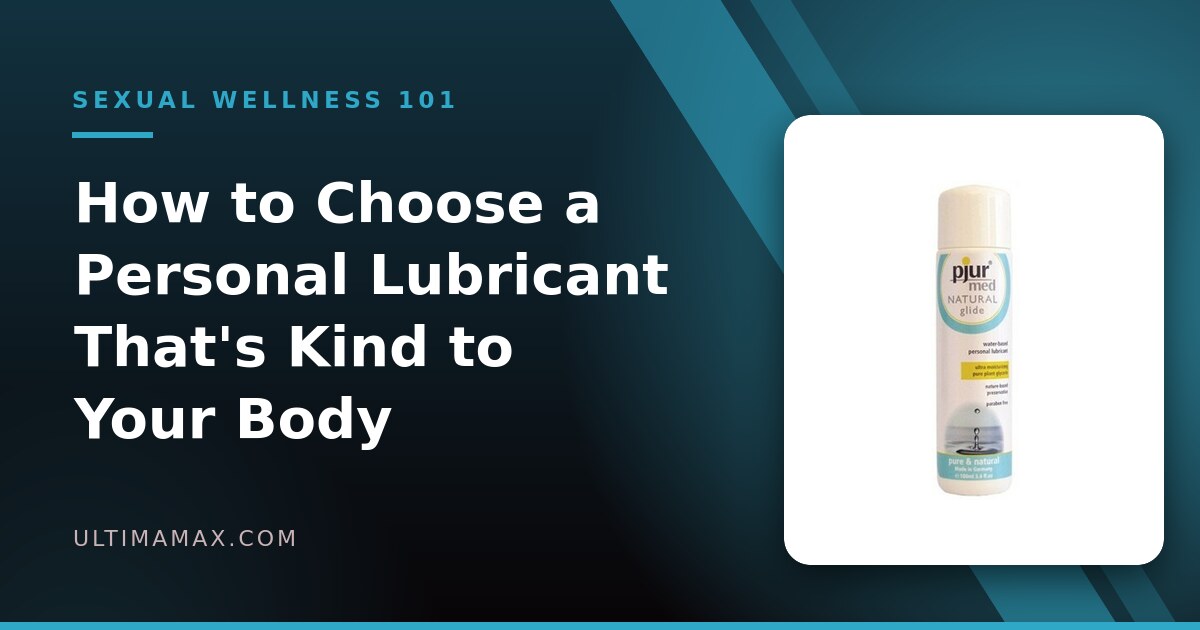
If you want to see what a deliberately minimal water-based formula looks like, pjur's MED Natural glide is a useful reference point. The full ingredient list is seven items: water, glycerin, xanthan gum, benzyl alcohol, sodium benzoate, potassium sorbate and citric acid.
What that list tells you: xanthan gum is doing the thickening rather than a heavy glycol load; citric acid is there to hold the formula on the acidic side; the preservative system uses nature-identical benzoate and sorbate rather than parabens. It is free of synthetic colours, fragrance, paraffin and oil, dermatologically tested for skin and mucous-membrane compatibility, and latex-condom safe.
Honest caveat: it does contain plant-derived glycerin, and pjur does not publish an osmolality figure on the retail bottle. If you get recurrent yeast infections, a glycerin-free formula from the organic lubricant range is the more cautious starting point.
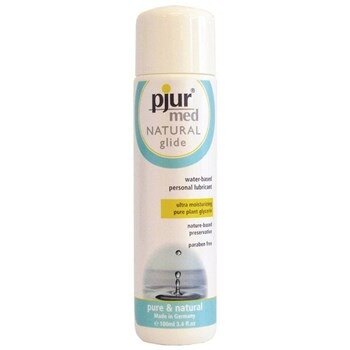
pjur MED Natural Water-Based Personal Lubricant, 3.4 oz
Seven-ingredient water-based glide with nature-identical preservatives. Hypoallergenic, latex-condom safe, fragrance and paraffin free, and formulated for hypersensitive skin and daily use.
View productHow it compares to the drugstore standard
For contrast, K-Y Jelly — the most recognised water-based lubricant in the United States — lists water, glycerin, hydroxyethylcellulose, gluconolactone, methylparaben, sodium hydroxide and chlorhexidine digluconate. It is effective, cheap and widely available. It also contains a paraben and an antiseptic, which is exactly the trade-off to weigh if you have sensitive tissue or a history of recurrent BV.
Lubricant, menopause and vaginal dryness
Lubricants and vaginal moisturisers are different products. A lubricant is used at the time of sex to reduce friction. A moisturiser is used on a regular schedule — typically every two to three days — to rehydrate tissue whether or not sex is happening. Many people going through menopause need both.
Falling oestrogen thins the vaginal epithelium and reduces natural secretions. When that shows up alongside urinary urgency or repeat urinary tract infections, clinicians call it genitourinary syndrome of menopause. The American College of Obstetricians and Gynecologists' guidance on vaginal dryness recommends over-the-counter moisturisers and lubricants as the first step, favours water-based lubricants, and advises skipping oil-based products.
The Office on Women's Health makes the same point, and adds the part worth repeating: dryness that causes small tears raises infection risk, so it is worth treating rather than tolerating. If over-the-counter products are not enough, the 2025 AUA/SUFU/AUGS guideline on genitourinary syndrome of menopause covers the prescription options to raise with your clinician — low-dose vaginal oestrogen among them.
How to actually use lubricant well
- Use more than you think. The most common mistake is a cautious dab. Start with a teaspoon-sized amount.
- Apply to both partners, and to the outside of a condom as well as the entrance — not just to one surface.
- Reapply without ceremony. Water-based formulas absorb and evaporate. A few drops of water will often reactivate slip without opening the bottle again.
- Patch-test anything new on the inner forearm or inner thigh for a few hours before internal use, especially warming, tingling or flavoured formulas.
- Match the base to the toy. Silicone toy plus water-based lube. Glass, stainless or ABS plastic — anything goes.
- Check the cap and the date. Water-based lubricants are preserved but not sterile; replace anything that has changed colour, smell or texture.
- Clean toys afterwards with a dedicated cleaner rather than household soap, which can leave residue on porous surfaces.
When lubricant is not the answer
Lubricant solves friction. It does not solve pain. If penetration hurts even with generous lubrication, that pattern points to something a bottle cannot address — pelvic floor muscle tension, vulvodynia, vaginismus, endometriosis, an infection, a skin condition such as lichen sclerosus, or the tissue changes of menopause. The MedlinePlus overview of sexual problems in women is a good plain-language starting point, and any of those conditions is treatable once it has a name.
Book the appointment if you notice: pain that persists despite lubricant, bleeding after sex, burning or itching that outlasts the encounter, an unusual discharge or odour, or a new reaction to a product you have used before.
Frequently asked questions
Is it normal to need lube?
Yes. Natural lubrication varies with hormone levels, medication, hydration, stress, arousal time and the menstrual cycle. Hormonal contraceptives, antihistamines, antidepressants, breastfeeding and menopause all reduce it. Using lubricant is routine maintenance, not evidence of a problem.
Can I use coconut oil as lube?
Not with latex condoms — oil degrades latex and causes breakage. Coconut oil is also difficult for the vaginal environment to clear and may encourage bacterial or yeast overgrowth in people who are prone to it. For external massage it is fine; for internal use with condoms it is not.
Does lube expire?
Yes. Most water-based lubricants carry a shelf life of two to three years unopened, and a period-after-opening symbol on the bottle. Discard anything that separates, changes colour or smells different.
What lube is safe with silicone toys?
Water-based, always. Silicone lubricant reacts with silicone toy surfaces over time, leaving them tacky or pitted. If you only own silicone lubricant, roll a condom over the toy.
Is glycerin in lube bad for you?
Not inherently. Glycerin is a humectant that adds slip and is used safely in many formulas. The issue is concentration: high glycerin content raises osmolality, which can dehydrate vaginal tissue. If you get recurrent yeast infections, a glycerin-free water-based lubricant is a reasonable switch to try.
Can lubricant be used with condoms?
Water-based and silicone-based lubricants are safe with latex condoms and are actively recommended, since adequate lubrication reduces the risk of breakage. Oil-based products are not. Polyurethane condoms tolerate oil, but latex and polyisoprene do not.
What is the difference between a lubricant and a vaginal moisturiser?
A lubricant is applied at the time of sex and works for that encounter. A moisturiser is applied on a regular schedule to rehydrate the tissue itself and works over days. People with menopause-related dryness often use both.
Sources and further reading
- WHO/UNFPA/FHI360 — Use and procurement of additional lubricants for male and female condoms: advisory note
- Characterization of Commercially Available Vaginal Lubricants: A Safety Perspective (National Library of Medicine)
- Lubricants for the promotion of sexual health and well-being: a systematic review (National Library of Medicine)
- CDC — Condom Use: An Overview
- ACOG — Experiencing Vaginal Dryness? Here's What You Need to Know
- Office on Women's Health — Menopause symptoms and relief
- AUA/SUFU/AUGS — Genitourinary Syndrome of Menopause Guideline (2025)
- MedlinePlus — Women and sexual problems
Medical disclaimer. This article is educational and is not medical advice. It does not diagnose, treat, cure or prevent any disease. Personal lubricants are regulated by the U.S. Food and Drug Administration as medical devices; product ingredient lists change, so always read the label on the bottle you have bought. If you have persistent pain, bleeding, irritation or recurrent infections, speak to a qualified healthcare professional.