
Key takeaways
- Vacuum devices work by physics, not chemistry. Negative pressure draws blood into the penis; a constriction ring holds it there.
- They are a recognised treatment for erectile dysfunction. The National Institute of Diabetes and Digestive and Kidney Diseases lists them alongside oral medication and injections.
- No drug interactions. That matters if you take nitrates, where PDE5 inhibitors are off the table.
- Novelty pumps and FDA-cleared medical devices are not the same product. Know which one you are buying and why.
- Thirty minutes is the hard limit for a constriction ring. Longer risks tissue injury.
- Pumping does not permanently enlarge the penis. Any device promising that is overselling.
- New erectile difficulty deserves a check-up — it is often the first visible sign of cardiovascular disease or diabetes.
Penis pumps occupy a strange spot in the market. Half the shelf treats them as a novelty; the other half is durable medical equipment that urologists prescribe and insurers sometimes cover. Both are the same basic machine — a cylinder, a pump and a valve. What separates them is regulation, build quality and whether the design includes the one part that actually sustains an erection. Here is how the mechanism works, what the evidence supports, and where the safety lines are.
How does a vacuum erection device work?
A vacuum erection device places a sealed cylinder over the penis and removes air from it. The resulting negative pressure draws blood into the corpora cavernosa — the two spongy chambers that fill during a natural erection. A constriction ring rolled to the base then traps that blood so the erection persists after the cylinder is removed.
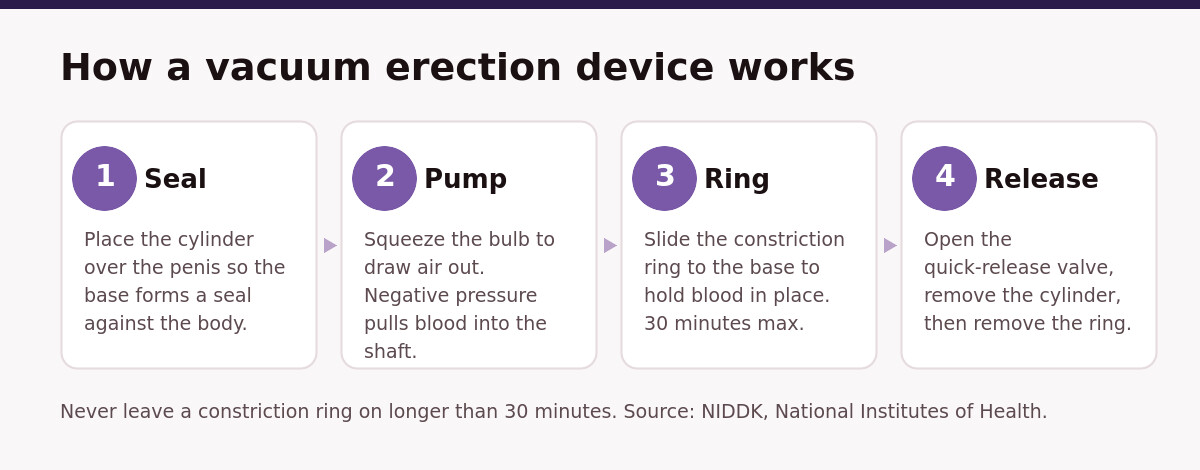
The elegance of the approach is that it bypasses the usual bottleneck. A natural erection depends on a signalling chain: arousal, nerve signals, nitric oxide release, smooth-muscle relaxation, blood inflow. Oral ED medication works partway along that chain, which is why it fails when nerve damage or severe vascular disease has broken a link earlier on. A vacuum device skips the chain entirely and moves the blood mechanically.
The NIDDK notes that vacuum devices are one of the standard treatment routes for erectile dysfunction, and describes the trade-offs plainly: the penis can feel cold or numb, may look purple or bruised, and ejaculation may be weaker — though that generally does not reduce the pleasure of orgasm.
Do penis pumps actually work?
For producing an erection sufficient for intercourse, yes — vacuum devices are effective for a large majority of men who use them correctly, which is why they appear in mainstream urology guidance. For permanently increasing penis size, no. There is no good evidence that pumping produces lasting enlargement.
Two claims get conflated constantly, so it is worth separating them:
Claim 1: a pump can produce a usable erection
Well supported. This is the entire clinical rationale for the device category, and it is why vacuum erection devices are offered to men who cannot take PDE5 inhibitors, who have not responded to them, or who are rehabilitating erectile function after prostate surgery. Clinicians sometimes prescribe daily pump use after radical prostatectomy specifically to keep oxygenated blood moving through penile tissue during the recovery window.
Claim 2: a pump permanently enlarges the penis
Not supported. The swelling from a pumping session is temporary oedema and blood volume, and it subsides. Aggressive over-pumping in pursuit of size is where the injuries happen — burst capillaries, bruising, blistering, and in extreme cases damage to the tissue that makes erections possible in the first place. If the marketing on a box leans on permanent gains, treat that as a signal about the manufacturer, not about the physics.
Novelty pump vs medical device: what is the difference?
An FDA-cleared vacuum erection device is a Class II medical device that includes a pressure-limiting mechanism and a constriction ring, and is sold with clinical instructions. A novelty pump is a cylinder, a bulb and a release valve — usually with no pressure limiter and no ring. Both create suction; only the first is designed to sustain an erection after the cylinder comes off.
| FDA-cleared vacuum erection device | Novelty / entry-level pump | |
|---|---|---|
| Regulatory status | Class II medical device, 510(k) cleared | Sold as a novelty item |
| Pressure limiter | Yes — caps vacuum at a safe level | Usually not |
| Constriction ring included | Yes | Often not |
| Typical price | $150–$500 | $15–$60 |
| Insurance coverage | Sometimes, with a prescription | No |
| Best suited to | Diagnosed ED, post-prostatectomy rehab | Sensation play, curiosity, temporary firmness |
This distinction matters more than any brand comparison. If you have diagnosed erectile dysfunction, the honest recommendation is to talk to a urologist about a pressure-limited device — you may be able to get one covered. If what you are after is the sensation, the temporary firmness before sex, or simply curiosity about how the mechanism feels, an entry-level pump is a low-cost way to find out.
A worked example: the Beginner's Power Pump
Pipedream's Beginner's Power Pump is a representative entry-level device, and useful to walk through precisely because it illustrates the category's limits. The specification is straightforward: a smooth flexible PVC opening, a medical-style hand bulb for suction, and a quick-release valve to break the vacuum. The cylinder measures 7.5 inches long with an internal diameter of about 2.23 inches.
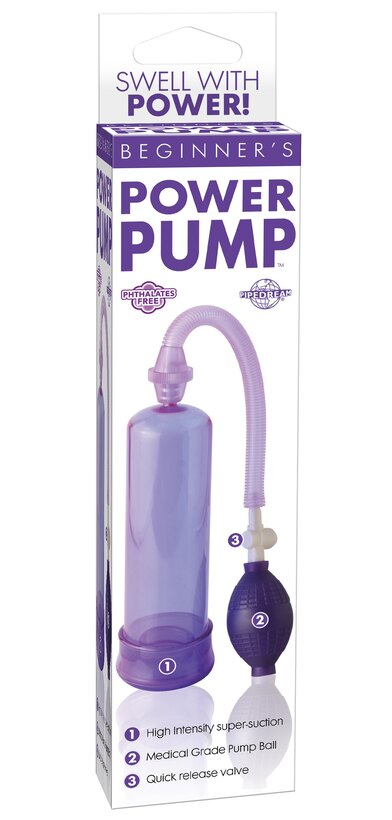
What it does include: the quick-release valve, which is the single most important safety feature on any pump, because it lets you drop the pressure instantly if something feels wrong. What it does not include: a pressure limiter or a constriction ring. That means suction depends entirely on your restraint, and the erection will begin to subside once the cylinder is removed.
Read that as a description of what the product is for, not a criticism. As a first, inexpensive way to understand how vacuum pressure feels and whether the approach suits you, it does the job. As a treatment for diagnosed erectile dysfunction, a pressure-limited device with a ring is the right tool. If you want to add sustain, a separate constriction ring pairs with any cylinder — just observe the same thirty-minute limit.
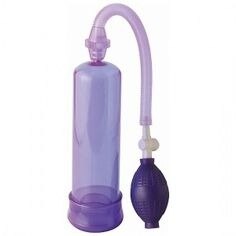
Beginner's Power Pump — Purple, Pipedream
Entry-level vacuum pump with a smooth flexible PVC sleeve, medical-style hand bulb and quick-release valve. 7.5 in cylinder, 2.23 in inner diameter. Ships in discreet packaging.
View productCompare the rest of the range in the penis pumps category.
How to use a vacuum pump safely
- Trim first. Pubic hair breaks the seal and gets pinched. A short trim at the base makes a real difference.
- Use water-based lubricant on the cylinder rim to form the seal. Silicone works too; oil will degrade PVC over time.
- Pump slowly. A few squeezes, then pause. Build pressure over minutes, not seconds.
- Release at any pain. Discomfort is a stop signal, not something to push through. Pinpoint pain, pins and needles, or a cold ache all mean release the valve now.
- Do not exceed roughly ten minutes of continuous vacuum. Release, rest, and repeat if you want more.
- Thirty minutes maximum for a constriction ring. This is the firmest rule in the whole category. Beyond that, tissue is deprived of oxygenated blood.
- Never use a ring while asleep, intoxicated, or when you cannot reliably track time.
- Clean after every use with warm water and mild soap, and let it dry fully. Damp PVC grows things you do not want.
Do not use a vacuum device without talking to a doctor first if you take blood thinners, have a bleeding disorder such as haemophilia, have sickle cell disease or another condition that predisposes to priapism, have Peyronie's disease or significant penile curvature, or have had a penile implant. Seek urgent care for an erection lasting more than four hours, severe pain, numbness that does not resolve, or skin that stays discoloured after the session.
What erectile difficulty is often telling you
This is the part of the conversation the industry tends to skip. Erectile function depends on healthy blood vessels, and the arteries that supply the penis are narrower than the coronary arteries. When plaque begins to restrict flow, the penile arteries often show it first — sometimes years before a cardiac event. That is why urologists treat new-onset erectile dysfunction as a prompt for a cardiovascular and metabolic work-up rather than an isolated complaint.
The NIDDK overview of erectile dysfunction lists the usual contributors: cardiovascular disease, diabetes, high blood pressure, obesity, low testosterone, smoking, excess alcohol, certain prescriptions, depression and anxiety. MedlinePlus covers the same ground in plainer language.
None of that is an argument against buying a pump. It is an argument for doing both — address the symptom, and get the blood work. A device that gets you through tonight is worth having. A conversation that catches undiagnosed diabetes is worth considerably more.
Vacuum device vs the alternatives
| Option | How it works | Main advantage | Main drawback |
|---|---|---|---|
| Vacuum erection device | Mechanical blood inflow | No drug interactions; reusable; works when medication does not | Requires setup; erection can feel cool or hinged at the base |
| PDE5 inhibitors (prescription) | Enhances the nitric-oxide pathway | Discreet, well studied | Contraindicated with nitrates; needs a prescription; needs arousal to work |
| Constriction ring alone | Restricts outflow | Cheap and simple | Only helps if you can achieve an erection already |
| Intracavernosal injection | Direct vasodilation | Highly effective | Injection; prescription; priapism risk |
| "Male enhancement" supplements | Unregulated botanical blends | Available over the counter | No premarket approval; the FDA repeatedly finds hidden prescription drugs in this category |
That last row deserves emphasis. The FDA maintains a running list of sexual enhancement and energy product notifications covering supplements found to contain undeclared sildenafil or tadalafil. Those hidden ingredients can interact dangerously with nitrates and drop blood pressure sharply. It is worth searching that database for any capsule you are considering — a pump, whatever else you say about it, has no ingredient list to hide.
Frequently asked questions
Do penis pumps permanently increase size?
No. Pumping produces temporary swelling from blood volume and fluid, which subsides within hours. There is no reliable evidence that vacuum devices produce lasting enlargement, and aggressive pumping in pursuit of it is the main cause of pump-related injury.
How long can you safely leave a constriction ring on?
Thirty minutes maximum. Beyond that, penile tissue is deprived of oxygenated blood and injury risk rises sharply. Never wear a ring while asleep or intoxicated.
Are penis pumps covered by insurance?
Sometimes. FDA-cleared vacuum erection devices prescribed for diagnosed erectile dysfunction may be covered as durable medical equipment, depending on your plan. Novelty pumps are not.
Does a vacuum pump hurt?
Used correctly it should not. Expect a firm pulling sensation and a feeling of fullness. Sharp or pinpoint pain, pins and needles, or a cold ache mean the pressure is too high — release the valve immediately.
Can I use a pump if I take nitrates for my heart?
This is one of the situations where a vacuum device has a genuine advantage over oral ED medication, since it involves no drug interaction. Still confirm with your cardiologist first, particularly if you also take anticoagulants.
How often can you use a penis pump?
Daily use is common in post-surgical rehabilitation protocols supervised by a urologist. For general use, allow tissue to recover between sessions, keep each vacuum period under about ten minutes, and stop entirely for a few days if you notice bruising or petechiae.
Do pumps work if I have nerve damage from diabetes or surgery?
Often yes, and this is one of their strengths. Because the device moves blood mechanically rather than relying on nerve signalling, it can still produce an erection when the signalling pathway is impaired. Discuss it with your urologist for your specific situation.
Sources and further reading
- NIDDK — Treatment for Erectile Dysfunction
- NIDDK — Erectile Dysfunction overview
- MedlinePlus — Erectile Dysfunction
- Cleveland Clinic — Vacuum Constriction Devices
- Mayo Clinic — Penis pump
- FDA — Sexual Enhancement and Energy Product Notifications
Medical disclaimer. This article is educational and is not medical advice. It does not diagnose, treat, cure or prevent any disease. The Beginner's Power Pump is sold as a novelty item and is not an FDA-cleared medical device; it is not a treatment for erectile dysfunction. If you have persistent difficulty achieving or maintaining an erection, please see a qualified healthcare professional — it is a common and treatable condition, and it can be an early indicator of cardiovascular disease.