
Key takeaways
- "Warming" describes three unrelated mechanisms. Solvent chemistry, blood-vessel dilation, or nerve-channel activation — the label word is the same, the biology is not.
- Capsaicin heat is your pain system firing. It activates TRPV1, a receptor whose normal job is signalling noxious heat.
- Menthol is dose-dependent. Low concentrations read as pleasant cooling; higher ones tip into cold hypersensitivity and pain.
- Vulvar and vaginal tissue is not forearm skin. A product that tingles nicely on a fingertip can genuinely burn on mucosa.
- Patch-test everything. Inner thigh, small amount, wait a few hours. This is the whole safety protocol and it takes one evening.
- Wipe first, then wash. Water alone spreads oil-soluble irritants like menthol rather than removing them.
- Skip them entirely if you have recurrent BV or thrush, broken skin, a salicylate or aspirin sensitivity, or you are using them anally.
Warming and tingling lubricants are among the most-returned products in the category, and the reason is almost always the same: the buyer assumed "warming" meant one thing and got another. The word covers at least three unrelated mechanisms, one of which works by politely tapping on your pain receptors. Knowing which one is in the bottle tells you whether it will suit you — and what to do in the ten minutes after it does not.
How do warming lubricants actually work?
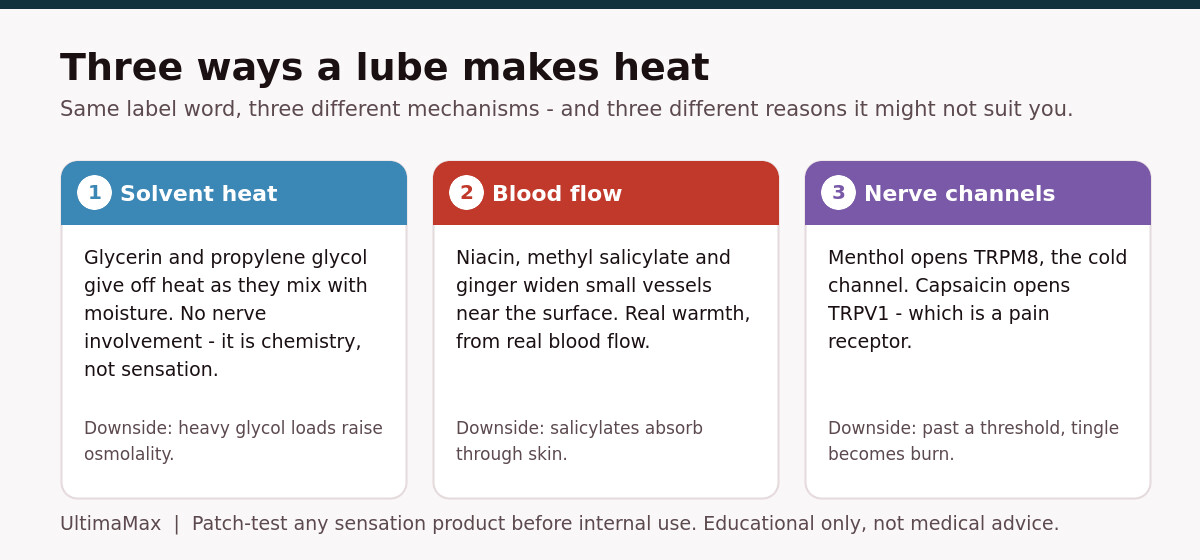
Three different ways. Some create heat chemically as solvents like glycerin and propylene glycol mix with moisture. Some contain vasodilators — niacin, methyl salicylate, ginger — that widen surface blood vessels, producing genuine warmth. Some contain menthol or capsaicin, which do not change temperature at all but activate the nerve channels that report hot and cold.
1. Solvent heat
The cheapest effect to formulate. Glycerin and propylene glycol release a small amount of heat as they dissolve into moisture, which is why some warming lubes feel warmer if you breathe on them. No nerve is involved — it is chemistry, and it fades in a minute or two.
The catch is what a heavy glycol load does to osmolality. Concentrated humectants pull water out of the tissue they sit on, and the WHO/UNFPA/FHI360 advisory note recommends staying under 1,200 mOsm/kg for exactly that reason. Warming formulas built on glycols are structurally more likely to run high — a point covered in the published safety analysis of commercial vaginal lubricants.
2. Vasodilation
Genuine warmth, because more blood is genuinely arriving. Niacin (nicotinic acid) produces the same flush that high-dose niacin supplements are notorious for. Methyl salicylate — wintergreen — is the counter-irritant in muscle rubs. Ginger extract works through a related pathway.
This is the mechanism most likely to feel like the marketing promised. It is also the one with a real systemic footnote: methyl salicylate is absorbed through skin, and salicylate absorption from topical products is well documented in the literature. That matters if you are sensitive to aspirin, take anticoagulants, or are applying it to a large area or to mucosa, which absorbs far more readily than forearm skin.
3. Nerve channel activation
The clever one, and the one worth understanding properly. Menthol binds TRPM8, the receptor that reports cold — described in the NIH's own reference text as the cold and menthol receptor. Nothing gets colder; the channel simply opens and your brain reads "cool."
Capsaicin binds TRPV1 — the channel that normally opens above roughly 42°C. TRPV1 is a nociceptor: a receptor whose job is to report potentially damaging heat. The psychophysics of capsaicin and TRPV1 is the study of exactly this — a burn sensation with no burn. Pleasant at low intensity for some people, and unambiguously pain at higher ones.
The dose line is real, not theoretical. Reviews of menthol in pain and analgesia describe low to moderate concentrations producing pleasant cooling, while higher concentrations induce cold allodynia and hyperalgesia — pain from a stimulus that should not hurt. Consumer products rarely print their concentration, which is why a patch test is not optional caution but the only measurement available to you.
Reading a sensation-product label
| Ingredient | What it does | Worth knowing |
|---|---|---|
| Menthol | Opens TRPM8 — cooling, tingling | Dose-dependent; tips into pain at higher concentrations |
| Capsaicin / capsicum | Opens TRPV1 — burning heat | TRPV1 is a pain receptor. Very hard to wash off |
| Methyl salicylate | Counter-irritant, vasodilator | A salicylate — absorbed through skin. Avoid with aspirin sensitivity |
| Niacin / nicotinic acid | Flushing vasodilator | Genuine warmth and redness; can feel intense on mucosa |
| Ginger root extract | Mild TRPV1 activity | Gentler than capsaicin, same family of effect |
| Propylene glycol / glycerin | Solvent warmth, humectant | Heavy loads raise osmolality; PG is a common contact irritant |
| Parabens | Preservative | Effective; an irritant for those sensitised to them |
| Diazolidinyl urea | Preservative | A formaldehyde releaser — a recognised contact allergen |
| FD&C colours, flavour | Appearance and taste | Among the commonest causes of contact irritation. Keep external |
Two label phrases deserve particular attention on this shelf. "For external use only" means what it says — plenty of tingling gels carry it while being merchandised alongside internal lubricants. And "novelty use only", which appears on a surprising number of arousal gels, is a manufacturer declining to make any claim about the product at all.
A worked example: what is in a warming clitoral serum
Crazy Girl's Oh My warming stimulant is a useful specimen because its ingredient list is short and legible: PEG-8, PEG-75, methyl salicylate, niacin, Smilax root extract, ginger root extract, polysorbate 20 and phenoxyethanol.
Read that and you can predict the experience before opening it. There is no menthol and no capsaicin, so it is not a nerve-channel product — the warmth comes from methyl salicylate plus niacin, both vasodilators, supported by ginger. That means real blood-flow warmth rather than a phantom tingle, applied in small amounts to the clitoris rather than used as a lubricant. It is fragrance free and paraben free, and the PEGs are carriers rather than a glycerin-style humectant load.
It also tells you who should skip it: anyone with a salicylate or aspirin sensitivity, since methyl salicylate is the second active ingredient and mucosa absorbs more readily than skin.
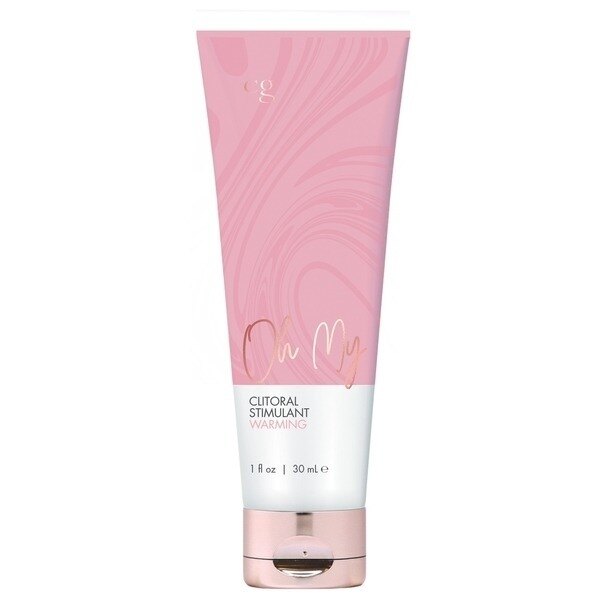
Crazy Girl Oh My Clitoral Stimulant, Warming — 1 oz
Eight-ingredient warming serum working through vasodilation rather than nerve-channel activation. Fragrance free, paraben free, no mineral oil. Applied in small amounts to the clitoris — not a lubricant.
View productCompare the wider arousal gels and creams range, or the warming lubricants category if you want the sensation in a full-volume lubricant rather than a serum.
How to patch-test properly
Thirty seconds of work that prevents the worst version of this experience.
- Start on the inner forearm with a rice-grain amount. Wait fifteen minutes. This screens for an obvious allergic reaction.
- Move to the inner thigh — thinner, closer to the tissue that matters. Same small amount, and wait a few hours this time. Delayed contact reactions are the ones people miss.
- Then try a small amount externally on the intended area, on an evening when stopping is not a disappointment.
- Only then use it as intended. Four steps sounds fussy; it is one evening against the alternative.
If it burns
- Wipe first with a dry soft cloth. This is the step people skip. Menthol and capsaicin are poorly water-soluble, so rinsing with water alone spreads them across a wider area.
- Then wash gently with a mild unscented soap and lukewarm water. Not hot — heat intensifies TRPV1 activation.
- Do not apply more lubricant to "dilute" it. A water-based product will carry the irritant further.
- A cool compress helps, and for oil-soluble irritants a little plain oil on a cloth lifts residue better than water. Milk on a cloth is the classic capsaicin trick and it works.
- Get medical help for blistering, swelling that spreads, breathing difficulty, or burning that persists for more than a few hours.
Who should avoid these entirely
- Anyone with recurrent bacterial vaginosis or thrush. Additional irritants and high-osmolality formulas are the wrong direction when the goal is a stable environment.
- Anal use. Rectal tissue is a single cell layer thick and there is no natural lubrication — see our guide to why anal lube rules are different. A sensation additive there is asking a fragile tissue to absorb an irritant.
- Broken skin, a healing tear, a recent wax, or active irritation. Wait until it has healed.
- Salicylate or aspirin sensitivity, for anything containing methyl salicylate.
- Anyone who has reacted to a sensation product before. Contact sensitisation tends to get worse with repeat exposure, not better.
If dryness rather than dullness is the actual problem, a sensation product is the wrong tool — a plain, well-formulated lubricant is. Our guide to choosing a personal lubricant covers that decision, and the ACOG guidance on vulvovaginal health is worth reading on why fewer added ingredients is usually the better bet for this tissue.
When irritation is telling you something else
A product that stings once is a product problem. Burning that keeps happening — with different products, or with none — is a different conversation. Persistent vulvar burning, itching or rawness can point to a yeast infection, bacterial vaginosis, contact dermatitis, lichen sclerosus, or vulvodynia, and all of those are diagnosable and treatable. MedlinePlus on sexual problems in women is a reasonable plain-language starting point before an appointment.
Book one for burning that outlasts the encounter, any blistering or ulceration, a discharge or odour change, or pain that has become the expected outcome rather than the exception.
Frequently asked questions
Are warming lubes safe to use?
For most people, used externally and in small amounts, yes. The risk is irritation rather than injury, and it varies enormously by formula and by person. Patch-test first, keep sensation products external unless the label says otherwise, and avoid them if you have recurrent infections, broken skin or a salicylate sensitivity.
Why does my tingling lube burn instead of tingle?
Usually concentration meeting sensitive tissue. Menthol produces pleasant cooling at low concentrations and pain at higher ones, and mucosa absorbs far more readily than the skin you may have tested on. It can also be a contact reaction to a preservative, dye or flavouring rather than to the sensation ingredient itself.
How do I get warming lube off if it hurts?
Wipe with a dry soft cloth first — water alone spreads oil-soluble ingredients like menthol and capsaicin. Then wash gently with mild unscented soap and lukewarm water. A cool compress helps. Do not add more lubricant to dilute it. Seek medical help for blistering, spreading swelling or burning lasting more than a few hours.
Can I use warming lube for anal sex?
Not advisable. Rectal tissue is a single cell layer thick, produces no lubrication of its own, and absorbs readily — a poor combination with an added irritant. Use a plain, thick, unflavoured lubricant instead.
What is the difference between a warming lube and an arousal gel?
A warming lubricant is a full-volume lubricant with a sensation ingredient added, used for glide. An arousal gel or serum is a small-volume product applied to a specific spot — usually the clitoris — for sensation only, and generally is not slippery enough to lubricate.
Does warming lube actually increase arousal?
It increases sensation, which is not the same thing. Extra sensory input can be genuinely welcome, particularly where sensitivity has dropped. It does not act on desire, and if low desire rather than low sensation is the issue, this category will not address it.
Can warming lube cause a yeast infection?
It can contribute. High-osmolality formulas and added irritants can disturb the vaginal environment and the lactobacilli that keep it acidic, and glycerin-heavy products are a common suspect for people prone to recurrence. If you get repeat infections, a plain glycerin-free lubricant is the more sensible choice.
Sources and further reading
- TRPM8: The Cold and Menthol Receptor (NCBI Bookshelf, National Library of Medicine)
- The distinctive role of menthol in pain and analgesia: mechanisms, practices and advances
- Integrating TRPV1 receptor function with capsaicin psychophysics
- Salicylate poisoning potential of topical pain relief agents
- Chemical burn from an over-the-counter topical analgesic containing menthol and methyl salicylate (case report)
- Characterization of commercially available vaginal lubricants: a safety perspective
- WHO/UNFPA/FHI360 — advisory note on additional lubricants for condoms
- ACOG — Vulvovaginal Health
- MedlinePlus — Women and sexual problems
Medical disclaimer. This article is educational and is not medical advice. It does not diagnose, treat, cure or prevent any disease. Ingredient lists change between production runs, so read the label on the product you have bought. If you experience blistering, spreading swelling, difficulty breathing, or burning that lasts more than a few hours, seek medical attention.